Traditional search engine optimization was built around a single objective: ranking in the ten blue links. That objective has not disappeared, but it is no longer sufficient. The rise of AI-generated answers in search results, through Google’s AI Overviews, Bing Copilot, and standalone tools like ChatGPT and Perplexity, has introduced two new disciplines that serious SEO practitioners are integrating into their service offering: Answer Engine Optimization (AEO) and Generative Engine Optimization (GEO).
For businesses evaluating their SEO investment in 2026, understanding what these terms mean in practice and how they change what good SEO work looks like is worth the time.

What AEO and GEO Actually Mean in Practice
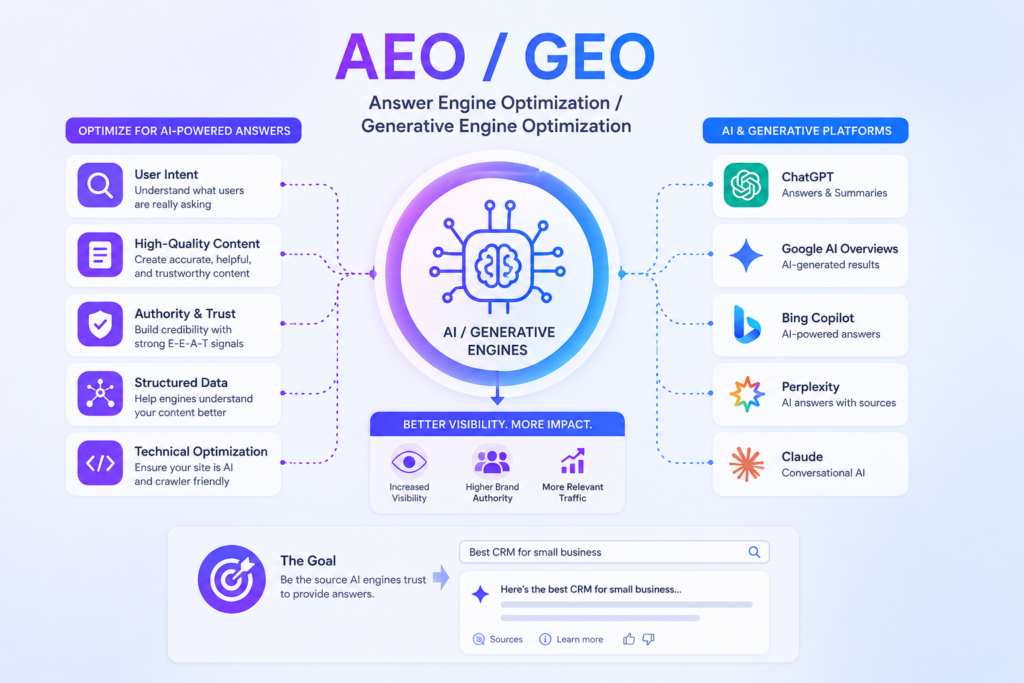
AEO refers to optimizing content so it is selected and surfaced by answer engines, including AI assistants and voice search platforms, rather than simply indexed and ranked by traditional search engines. The goal is for your content to be the source an AI cites or reads aloud when a user asks a question, rather than appearing as a link the user then chooses to click.
GEO is the broader discipline of optimizing for generative AI systems specifically. Where AEO focuses on structured, question-and-answer style content, GEO encompasses how content is written, structured, cited, and cross-referenced so that large language models consistently draw from it when generating responses across any platform.
The practical overlap is significant. Both require content that is authoritative, clearly structured, factually accurate, and written in ways that AI systems can parse and attribute reliably.
Why Traditional SEO Metrics Are No Longer the Full Picture
Organic click-through rates from search have been declining for several years as Google has expanded zero-click features, including featured snippets, knowledge panels, and People Also Ask boxes. AI Overviews, which began rolling out globally through 2024 and expanded significantly in early 2025, accelerate that trend.
A page that ranks in position one for a competitive query may now sit below an AI-generated summary that answers the user’s question without requiring a click. For informational queries, especially, this changes the value calculation of traditional ranking positions.
This does not make ranking irrelevant. Pages that rank well are more likely to be indexed and cited by AI systems. But ranking alone no longer guarantees traffic, which means SEO reporting and KPI frameworks need to evolve alongside the tactics.
How SEO Agencies Are Adapting Their Service Models
The shift toward AEO and GEO has created a clear divide between agencies still delivering traditional SEO services unchanged and those rebuilding their methodologies around how AI systems consume and attribute content.
Agencies operating at the more sophisticated end of the market are now conducting entity optimization audits, schema markup implementation for AI readability, structured content architecture reviews, and citation gap analyses that identify where competitors are being referenced in AI-generated responses and why.
This work requires a deeper technical and editorial skill set than traditional keyword targeting. For businesses in competitive markets, choosing an agency that has actively built AEO and GEO capability into its workflows matters more in 2026 than it did two years ago.
Structured Data and Schema: The Technical Foundation of AEO
If there is a single technical investment that pays dividends across both traditional SEO and AEO simultaneously, it is structured data implementation. Schema markup gives search engines and AI systems explicit, machine-readable information about what a piece of content is, who produced it, what it covers, and how it relates to other entities.
For AEO purposes, the most valuable schema types include FAQ schema, HowTo schema, Article schema with author entity markup, and Speakable schema for voice search optimisation. Pages with well-implemented structured data are more likely to be parsed accurately by AI systems and surfaced in response to relevant queries.
Google’s Rich Results Test and Schema.org documentation are the baseline references for implementation. For sites running on WordPress or similar CMS platforms, structured data plugins can handle basic implementation, but complex or e-commerce sites typically require developer involvement to get schema right at scale.
Content Architecture for Generative AI Visibility
The way content is written and organized has a direct bearing on whether AI systems select it as a source. Generative AI models favor content that makes clear claims, cites credible sources, answers specific questions directly, and is structured so individual sections can be extracted without losing meaning.
Long-form content that buries its key points inside an extended preamble performs worse in generative contexts than content that front-loads its answers. Headings that reflect genuine user queries, short declarative paragraphs, and explicit attribution of facts to named sources all contribute to AI readability.
Internal linking structure also plays a role. AI systems that crawl and index content use link relationships to establish topical authority. A site with a coherent internal linking architecture that clearly signals subject matter expertise is better positioned for generative visibility than one with orphaned pages and inconsistent topical coverage.
Measuring AEO and GEO Performance
One of the genuine challenges of AEO and GEO in 2026 is measurement. Traditional SEO has well-established reporting frameworks built around ranking positions, organic traffic, and conversion attribution. AI-driven visibility is harder to quantify because it often occurs without a traceable click.
Tools including Semrush’s AI Toolkit, Ahrefs’ AI search visibility features, and dedicated platforms like Profound and Otterly.ai have emerged specifically to track brand and content citations in AI-generated responses. These tools monitor how often a brand or domain appears in AI Overviews, ChatGPT responses, and Perplexity answers across tracked query sets.
For most businesses, the practical starting point is adding AI visibility tracking alongside, rather than replacing, existing rank tracking. The two data sets tell different parts of the same story: traditional rankings show where you appear in the list, while AI citation tracking shows whether your content is being used to answer questions directly.
What This Means for Businesses Investing in SEO in 2026
The businesses most at risk from the AEO and GEO shift are those whose SEO strategies were built entirely around informational keyword rankings. If your content strategy was designed to capture top-of-funnel traffic through how-to guides and explainer articles, a significant portion of that traffic may now be absorbed by AI-generated answers before it reaches your site.
The response is not to abandon content investment but to redirect it. Content that demonstrates genuine expertise, cites primary sources, takes clear positions, and is structured for AI readability compounds in value over time. It performs in traditional search, it gets cited in AI responses, and it builds the kind of topical authority that both human readers and AI systems recognize as credible.
The underlying principle of SEO has not changed: produce content that genuinely answers what your audience is looking for and distribute it in ways that help search systems find and trust it. What has changed is that the search systems now include AI, and the distribution signals they rely on are more sophisticated than keyword density and backlink count ever were.
Author Bio
Liam Ridings is the Founder of Safari Digital, a specialist SEO agency. With over a decade of experience across technical SEO, content strategy, and link acquisition, Liam works with businesses across Australia and Southeast Asia to build search visibility that drives measurable commercial outcomes. His work spans competitive verticals, including professional services, trades, and SaaS, with a focus on building sustainable organic growth through rigorous technical execution and authoritative content. Follow Safari Digital’s thinking on search at safaridigital.com.au.
Leave a Reply