Your chief financial officer asks a simple question. “What do we get for the money we spend on AI?” Many teams freeze. They have a demo and a few happy users. They don’t have numbers.
That gap hurts budgets. Good AI business consulting helps you answer that question before you spend. It ties every project to a business goal. It also sets the numbers you will track.
Think about a logistics company that adds route planning software. Couriers like it. Managers feel it helps. But nobody measured fuel use or delivery times before launch. Six months later, the finance team can’t prove any gain. The project looks like a cost, and the next budget request gets cut. Good ideas die this way every year.
This guide shows you how to measure AI ROI in plain steps. You will learn what to count and how to build a case. You will also see a simple example with real math. You don’t need a finance degree. You need a clear process and honest numbers. Let’s start with why this topic trips up so many smart teams.

Why Measuring AI Is Hard
Costs Are Easy to Count
Bills show up for cloud space and software licenses. Developers send invoices too. Finance sees every dollar. The spending side looks clear. Nobody argues about an invoice.
A strong AI business case lists those costs in full. Then it adds the hidden ones. Staff training takes time. Data cleanup takes time. Support work never really ends. Many teams forget these items. The project then looks cheap on paper and costly in real life. Leaders feel misled when the real bill arrives, and trust drops fast.
Benefits Are Harder to See
Benefits spread across many teams. A chatbot saves support agents a few minutes per ticket. A forecast tool helps a planner avoid one bad order. Each gain looks small alone. Together they add up, but nobody tracks the total. One manager sees a small win and moves on. Another manager never hears about it.
That’s why AI value creation often goes unnoticed. Pick one team and one metric for each project. Then you can see the gain clearly. Share that number with your leaders each month. Ask yourself this. If the tool vanished tomorrow, what would get worse?
Why Teams Skip Measurement
Most teams skip measurement for one reason. Building feels more fun than counting. Nobody sets a baseline. So, nobody can show a change later. Some leaders also worry about the answer. A weak result feels awkward to share. So the project keeps running. And the big question stays open.
This is where AI business consulting helps. An outside partner asks for numbers early. They also tell you the truth when results look weak. That saves you from funding the wrong project twice. It also protects your standing with finance.
What to Measure
- Cost Savings
Start with savings. They’re the easiest to prove. Count the hours your team no longer spends on a task. Multiply those hours by the hourly cost. Then add the cost of errors you now avoid. Keep a record of how you found each number. This gives you a solid base for AI ROI. A claims team, for example, might cut review time on each file. Fewer hours per file means real money saved every month. Finance teams like this kind of proof. They can check every step with their own sheets. - Revenue Gains
Some projects bring in new money. A recommendation engine may lift the average order size. A lead scoring tool may help sales close more deals. Track the extra revenue and compare it to the period before launch. Use the same length of time for both periods.Be careful with credit. Other factors also move sales. Seasons change buying habits. Promotions do too. A new competitor can cut your numbers. Smart AI business solutions let you test with a control group. One group uses the tool and another group doesn’t. The gap between them shows the true effect. Even a small test can settle an argument. - Benefits Without a Price Tag
Some wins have no clear dollar value. They still matter. Here are a few examples.- Faster customer response
- Better employee morale
- Lower compliance risk
- Quicker decisions
Don’t ignore these gains. Give each one a simple score or a rough value. Ask the team that feels the change for its view. A sound artificial intelligence strategy treats them as support for the main numbers. They never replace the main numbers. Share them as extra context in your report.
How to Build Your Business Case
Start With One Problem
Pick one problem to solve. Make it specific. “Improve customer service” is too wide. “Cut ticket handling time by a third” is clear and easy to test.
Talk to the team that owns the problem. Ask what slows them down today. Take notes on what they say. A focused enterprise AI strategy starts here. It links each project to a problem leaders already care about. That link makes budget talks much easier. Your leaders already feel the pain, so they listen.
Count All the Costs
List every cost before you ask for money. Use the table below as a guide.
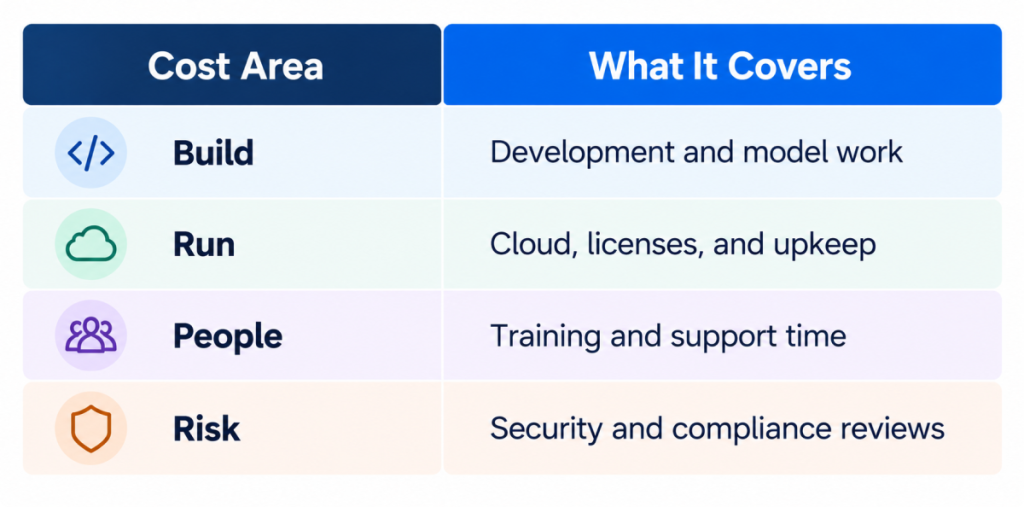
Have a buffer for surprises. Projects rarely cost exactly what you plan. Ask engineers for a low estimate and a high estimate. A sound AI investment strategy counts the full cost over three years. Numbers from the first year alone can mislead you. Many costs show up late, such as retraining and upgrades.
Set a Baseline
You can’t prove a gain without a starting point. Measure today’s numbers before launch. Ask the people who do the work. They often know the real numbers better than any report. Check at least one month of history if you can. Capture these basics.
- Time spent per task
- Error rate
- Cost per case
- Customer wait time
Write these down and share them with the finance team. Without a baseline, you only have opinions. Opinions rarely survive a budget meeting.
How to Calculate ROI
Use a Simple Formula
The basic formula is short. Take your total benefit and subtract your total cost. Divide the result by your total cost. Multiply by 100 to get a percentage. Use the same formula for every project. Write the result next to your original goal. Then everyone can see if you hit it.
Keep the math plain so everyone can check it. AI business consulting teams often build this model in a shared sheet. Leaders can then change the inputs and see results at once. That openness builds trust. People believe numbers they can test themselves. A hidden formula makes them suspicious.
Try a Sample Case
Here’s an example. A support team adds an AI assistant. The tool costs $100,000 in year one. It saves 3,000 agent hours at $30 an hour. That’s $90,000 in time value. It also cuts errors and saves another $30,000 in refunds, based on the pre-launch baseline.
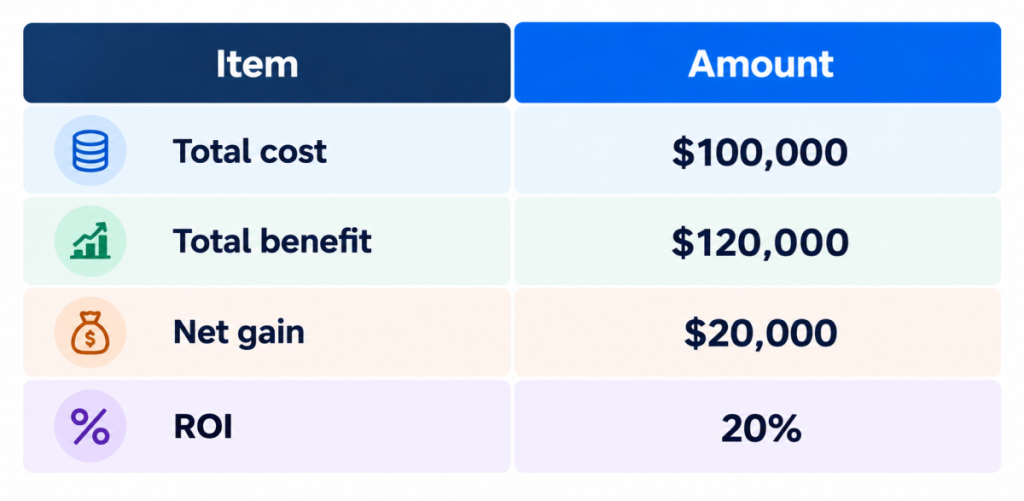
That’s a modest return. Year two usually costs less, so the return often grows. Strong AI business solutions tend to pay off more in later years. Plan your review for year two and year three.
Track Results Over Time
Measure after launch too. Check your numbers every month for the first quarter. Then check them every quarter. Compare them to your baseline. Write down what changed. Note why it changed too. Put the results in one simple report. Send it to the same people each time.
If gains slow down, find out why. Maybe users stopped using the tool. Maybe the data changed. Steady tracking supports AI value creation long after launch. It also gives you proof for your next budget request. Teams with a record of results get approved faster.
How Mobisoft Infotech Helps
Find the Right Use Cases
Mobisoft Infotech follows a process with three steps.
- Discover
- Strategize
- Execute
Discovery starts with your goals and data. The team also runs an AI maturity assessment to show where you stand today. The review looks at your data first. It then looks at your team skills. Gaps show up early this way. You hear the truth before you commit money.
AI strategy consulting from this team ranks use cases by value and effort. You start with the ones most likely to pay off. Certified AI specialists guide that ranking. You get a short list instead of a long wish list.
Build the Business Case
Next, the team helps you write a case that finance can trust. It covers these parts.
- A clear problem statement
- A full cost estimate
- Baseline metrics
- Expected return and timeline
Your leaders see the logic behind each number. A strong AI business case gets approval faster. It also sets clear targets for the project team. Everyone knows what success looks like.
Measure and Improve
Once the solution is designed and set up, the team tracks the results through dashboards. The team compares performance to the baseline. Any team member can access dashboards at any moment. No need to wait for a quarterly slide presentation of results.
Flexible engagement models help you start measuring on a small scale. First, show the value of the solution on one project. Then, proceed to scaling.
Data security is guaranteed at all stages. The team provides continuous support. You get measurable AI ROI. This allows making adjustments early to avoid losses in the future.
Review all results together with your team monthly. Discuss achievements and issues. Share everything with the finance department. Trust builds through transparency; unexpected results will ruin it.
Final Thoughts
It is quite simple to measure the impact of AI on your organization. Just choose one issue to solve and set a baseline. Calculate costs and track the ROI. All these four practices help transform vague promises into real proof. Nothing is required in terms of specialized tools to do that.
A good enterprise AI strategy involves measuring ROI and considering it while making decisions. In this case, leaders can easily back the correct projects and reject those that are not promising. This practice is appreciated by the finance departments because it provides clear figures and fewer questions. Moreover, the team develops faster since every project provides results.
Choose an existing AI project in your company and list all the costs associated with it. List all the benefits as well. The absence of data will give a hint on where to start. Share your results with the finance department and receive their feedback.
Professional AI business consulting makes this process easier. A partner has templates and an objective opinion. You make fewer mistakes and arrive at a decision earlier. Every measurement gets simpler for the following ones.
Leave a Reply